
Manage Past Clients with Real Estate CRM
Real Estate, Client Management, CRM
How to Use a Real Estate CRM to Manage Past Clients at Scale
For any real estate agent who wants a predictable, referral-rich business, past clients are your greatest asset. Yet as your database grows from dozens to hundreds or even thousands of contacts, staying personally connected becomes impossible without the right real estate systems. A well-implemented real estate CRM turns chaotic spreadsheets and sticky notes into a scalable, repeatable engine for long-term real estate client management and real estate follow up.
Why Past Clients Deserve a Dedicated System
Most experienced real estate agents know that repeat and referral business should make up a large percentage of annual closings. Past clients already trust you, understand your process, and are surrounded by people who will eventually need real estate services. The problem is not a lack of opportunity; it is a lack of consistent, thoughtful real estate follow up at scale.
Without a real estate CRM, you are relying on memory and scattered notes. That approach works for 20 clients, but not for 200. A modern CRM gives you scalable solutions for realtors by centralizing data, automating touchpoints, and surfacing who needs attention and when. Used correctly, it becomes the backbone of your real estate client management strategy for years after closing day.
Step 1: Clean and Organize Your Past Client Database
Effective real estate systems start with clean data. Before building campaigns or automations, take the time to organize every past client in your real estate CRM. This is tedious once, but it pays off every single day afterward for the busy real estate agent or team leader.
Standardize contact records: Ensure each past client has full name, phone, primary email, home address, and preferred communication method (text, email, call, or social).
Add transaction details: Record close date, property type, price point, and whether they were buyer, seller, or both. This context fuels relevant real estate follow up later.
Tag and segment: Use tags such as “A+ referrer,” “Investor,” “First-time buyer,” “Luxury,” or “Relocation” so you can send targeted messages instead of generic blasts.
The goal is to transform your CRM from a static address book into a living database that reflects relationships, not just transactions. When an experienced real estate agent opens a contact record, they should immediately see who this person is, what they bought or sold, and how engaged they have been since closing.
Step 2: Design a Scalable Post-Closing Follow-Up Plan
Once your data is organized, the next step is to design a repeatable post-closing plan that your real estate CRM can execute automatically. Think in terms of touchpoints over time, not one-off check-ins. A strong real estate client management plan blends automation with personal touches so clients feel remembered, not marketed to.
Immediate post-closing sequence (first 30–60 days): Use your CRM to schedule a “congratulations” email, a move-in tips resource, and a quick survey about their experience. Add a reminder for a personal call or handwritten note within the first week.
First-year nurture: Automate touchpoints at key milestones—30 days, 90 days, 6 months, and 1 year. These can include home maintenance checklists, local contractor recommendations, or a simple “How is the new place feeling?” message.
Anniversary and birthday reminders: Your CRM should automatically surface home purchase anniversaries and birthdays so you can send a quick video message, card, or text. This is low-effort, high-impact real estate follow up that keeps you top of mind.
The power of real estate systems lies in consistency. When every past client is automatically placed into the same proven follow-up plan, you no longer depend on willpower or memory. Your real estate CRM quietly runs the playbook in the background while you focus on active deals.
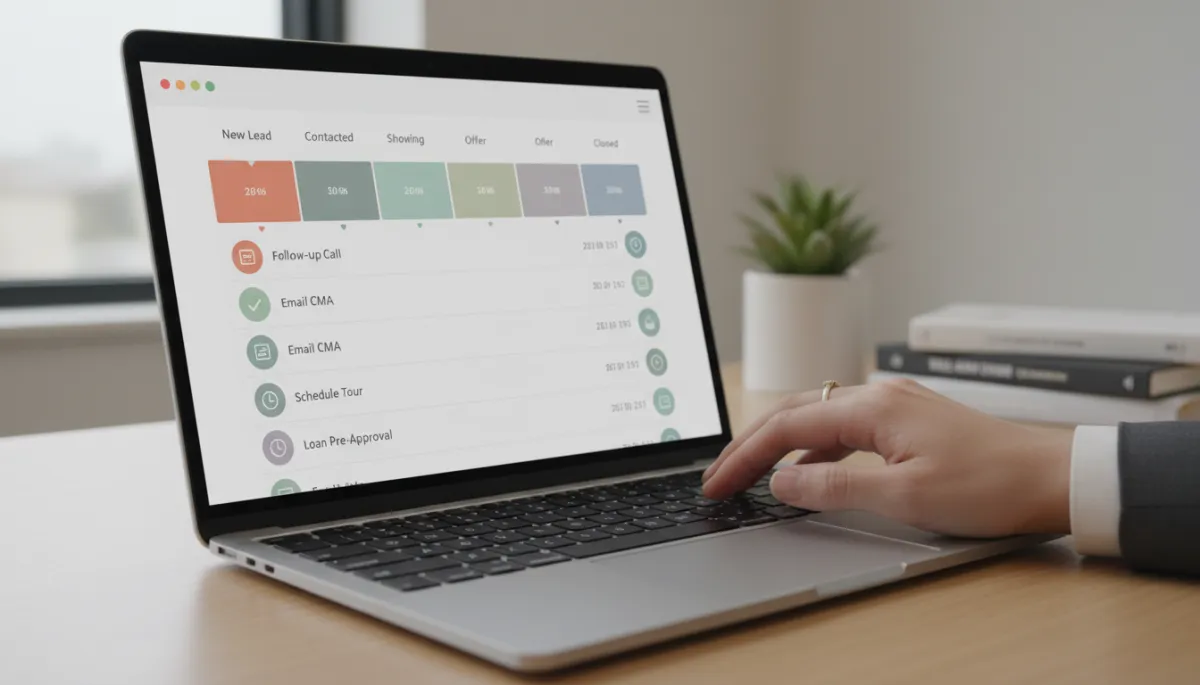
Automated workflows ensure every past client receives timely, consistent follow-up for years.
Step 3: Segment Past Clients for Hyper-Relevant Communication
Not all past clients need the same message. An investor buying multi-unit properties requires very different information from a first-time buyer in a starter home. A sophisticated real estate CRM gives you the flexibility to create segments and deliver communication that feels tailored, even when you are using scalable solutions for realtors.
By property type: Separate condo owners, single-family homeowners, investors, and luxury clients so you can send relevant market updates and opportunities.
By engagement level: Tag “raving fans,” “occasional responders,” and “cold” contacts. Increase personal touches for your best advocates and re-engagement campaigns for quieter clients.
By timeline: Use close dates to group clients likely to consider moving again soon—upsizers, downsizers, or those nearing the typical 5–7 year cycle.
When an experienced real estate agent sends a quarterly email that speaks directly to a client’s situation—like “What rising interest rates mean for condo owners in your building”—it feels personal, not automated. Yet behind the scenes, your real estate systems are doing the heavy lifting.
Step 4: Blend Automation with Authentic Human Touch
A common fear among real estate professionals is that automation will make them sound robotic. In reality, a smart real estate CRM helps you be more human by freeing up time and reminding you when a personal touch matters most. Think of automation as the skeleton and your personality as the muscle.
Use automated emails for educational content, market updates, and reminders, but personalize the first few lines with merge fields like name, neighborhood, or property type.
Set CRM tasks for live touches: quarterly “client care calls,” handwritten notes, or short video messages. The system tells you who to contact and why; you show up as the trusted advisor.
Track responses inside the CRM so your future communication can reference previous conversations, reinforcing that you genuinely remember and care.
💡 Pro Tip: Record a library of evergreen video messages—congratulations, home maintenance tips, “thinking of you” check-ins—and let your real estate CRM insert them into automated campaigns for a personal feel at scale.
Step 5: Track Referrals, Reviews, and Lifetime Value in Your CRM
Managing past clients at scale is not just about staying in touch; it is about measuring the impact. A robust real estate CRM allows you to track who sends referrals, who leaves online reviews, and how much lifetime value each relationship generates. This insight helps the serious real estate agent double down on what works.
Create a custom field or tag for “Referral Source” and update it whenever a past client sends you a new lead. Over time, you will see who your top advocates are.
Log when a client leaves a review on Google, Zillow, or other platforms. Trigger a thank-you note or small gift using CRM tasks or automations.
Run reports on repeat and referral transactions versus cold leads. This data proves the ROI of your real estate systems and justifies continued investment in scalable solutions for realtors.
Over time, you will notice that a relatively small group of loyal past clients can drive a significant percentage of your GCI. Your CRM makes sure those relationships receive the attention they deserve, even when your active pipeline is full.
Step 6: Systematize Client Events and Value-Add Touches
Many experienced real estate agents host client appreciation events, seasonal giveaways, or educational webinars. These are powerful loyalty builders, but they can become overwhelming without structure. Your real estate CRM can manage invitations, RSVPs, reminders, and follow-up, turning what used to be a spreadsheet nightmare into a smooth, repeatable process.
Create an “Event” tag or list and add relevant past clients based on location, engagement, or niche (for example, “Families with kids under 10” for a pumpkin patch event).
Build an email and text sequence for save-the-dates, official invitations, reminder messages, and post-event thank-you notes. Save this as a template you can reuse every year.
Track attendance and engagement inside the CRM so you know which events resonate most with your database and which clients are highly connected to your brand.
When events are powered by organized real estate systems, they stop being one-off marketing stunts and become strategic touchpoints in a long-term relationship plan.
Bringing It All Together: Building a Referral-Driven, Scalable Business
Managing past clients at scale is no longer a luxury reserved for large teams. With a thoughtfully configured real estate CRM, solo agents and growing teams alike can deliver a high-touch experience to hundreds of households without burning out. The key is to approach your database like an experienced real estate agent approaches a listing: with a clear strategy, strong systems, and disciplined execution.
Centralize your data, design a long-term real estate follow up plan, segment your audience, blend automation with authenticity, and measure results. When you treat every past client as a relationship to be nurtured—not just a closed file—your CRM becomes more than software. It becomes the engine behind a stable, referral-based business and one of the most powerful scalable solutions for realtors in a competitive market.
The technology is already available. The differentiator is how intentionally you use it. Start by upgrading how you manage yesterday’s clients, and you will quietly transform tomorrow’s pipeline.
Shawn Bell is the founder of The Realtors Blueprint, a system installation platform built specifically for experienced agents. If you recognized your business in this article, the [Leak Check] shows you exactly where your follow-up infrastructure is breaking down — and what to fix first.


